Written by Dr Katherine Sparks (BVSC) of MediVet Hillcrest
If you’ve ever looked inside your young dog’s mouth and noticed what appears to be a collection of tiny, cauliflower-like warts, you may understandably be worried.
The good news is that oral papillomatosis is usually a benign and self-limiting viral infection. While the growths can look quite alarming, most affected dogs recover without any specific treatment.
What is oral papillomatosis?
Oral papillomatosis is caused by the canine papillomavirus. It most commonly affects puppies and young dogs whose immune systems haven’t yet developed strong immunity to the virus.
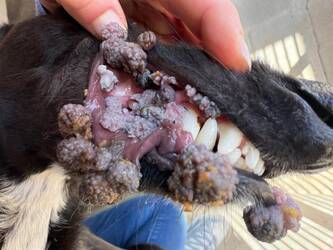
The papillomas are small, fleshy growths that often have a rough, frond-like or cauliflower appearance. They’re most commonly found around the lips, gums and inside the mouth, although they can occasionally occur around the eyes or on other areas of the skin.
They may appear very suddenly and can increase in number quite quickly.
How does my dog catch it?
Papillomavirus is contagious between dogs. It can spread through direct contact with an infected dog or through contaminated objects such as toys, food bowls and bedding.
There’s usually an incubation period of several weeks before the warts become visible, so your dog may have been exposed some time before you notice anything.
Importantly, canine papillomavirus isn’t the same virus that causes warts in people. It’s not considered a risk to humans.
What do the papillomas look like?
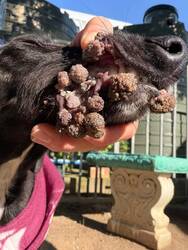
The classic oral papilloma has a distinctive rough, cauliflower-like appearance. Some dogs may have only a few lesions, while others can develop many throughout the mouth.
They can occur on:
-
Lips
-
Gums
-
Tongue
-
Inside the cheeks
-
Roof or back of the mouth
-
Occasionally around the eyes or on nearby skin.
Although they can look quite dramatic, the majority of cases aren’t dangerous.
Will they go away on their own?
Usually, yes.
A healthy dog’s immune system will generally recognise and eliminate the virus, causing the papillomas to gradually shrink and disappear. This commonly happens over a period of weeks to a few months.
Once a dog has developed immunity to that particular virus, they’re generally protected against reinfection with the same strain.
This is why treatment is often unnecessary if the dog is otherwise well and the papillomas aren’t causing problems.
When can they become a problem?
Occasionally, a dog can develop a very large number of papillomas. If there are many growths, they can interfere with:
-
Eating and picking up food
-
Chewing
-
Swallowing
-
Drinking
-
Normal mouth function.
Large or irritated papillomas can also be traumatised when a dog chews, resulting in bleeding or secondary bacterial infection.
If your dog is struggling to eat, is drooling excessively, has bad breath, appears to be experiencing pain when eating, or the lesions are bleeding, they should be examined by your veterinarian.
Does my dog need treatment?
Most dogs don’t require treatment and simply need monitoring while their immune system deals with the infection.
In more severe cases, treatment may be considered. Depending on the individual dog and the number and location of the lesions, your veterinarian may recommend removing troublesome papillomas or investigating other treatment options.
Because the condition commonly resolves naturally, it can sometimes be difficult to determine how effective a particular treatment is.
Do I need to keep my dog away from other dogs?
Because papillomavirus can spread between dogs, it’s sensible to avoid close contact with other dogs while visible papillomas are present, particularly puppies and dogs with compromised immune systems.
Don’t allow dogs to share bowls, toys or other items that are regularly mouthed by dogs.
The good news is that once the infection has resolved, the risk of transmission is considered to be much lower.
Is every wart-like lump in a dog’s mouth a papilloma?
No – and this is important.
Not every growth in a dog’s mouth is a papilloma.
Other benign growths and, more importantly, oral tumours can sometimes look similar. Oral growths in older dogs, solitary growths, lesions that are unusual in appearance, or growths that continue to enlarge rather than regress may require further investigation.
Your veterinarian may recommend a biopsy or removal of a lesion if there’s any doubt about the diagnosis.
What about older dogs?
Oral papillomatosis is particularly common in young dogs. If an older dog suddenly develops multiple papilloma-like growths, your veterinarian may want to investigate whether there’s an underlying problem affecting the immune system.
The bottom line
Oral papillomatosis can look far more frightening than it actually is.
In most young, otherwise healthy dogs, these strange little cauliflower-like growths are caused by a virus and eventually disappear as the dog's immune system develops a response.
However, don’t assume that every lump in your dog's mouth is “just a wart”. If you notice a new growth, particularly in an adult or older dog, or if the growth is causing discomfort or interfering with eating, have it checked by your veterinarian.
As a vet I’d always rather take a quick look and reassure you than have you worrying at home about something you've found in your pet's mouth.
Saving Altan

Written by Clare Travers of Animal Welfare Helderberg
Altan arrived at our shelter after he was found running around on the streets as a stray dog.
On arrival, his mouth and gums were severely infected with canine oral papillomas. It was one of the worst cases we’d ever seen – the gums inside his mouth had clusters and more clusters of warts on top of each other, filling his entire mouth. He struggled to eat. It really affected his quality of life.
An anonymous donor stepped forward after he was at the kennels for a few weeks and took him for a medical consultation at a specialist veterinary practice.
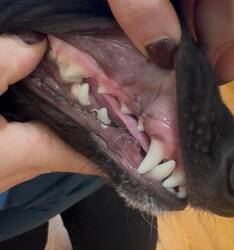
A treatment plan was worked out due to the fact that his immune system was very low. He had several surgeries performed a few weeks ago whereby the specialist vets were able to remove all the warts, and he’s now completely free of all the canine oral papillomas.
And – even more good news – Altan’s anonymous donor has adopted him!